
Updated 02/05/2026.
Please check this page regularly; the program is subject to last-minute changes. Here you can also download the program with the full list presentations.
PRESENTERS GUIDELINES
All presentations (excluding keynote speeches) will be 20 minutes in duration. Presenters are encouraged to follow the symposium guidelines to ensure clear communication and effective delivery.
Two rooms will be available, each equipped with a computer and the necessary connections for presentations. Please arrive at least 5 minutes before your session to upload your presentation to the room computer. USB flash drives will be available to facilitate the transfer process.
General Guidelines for Presenters
Welcome to the symposium! To ensure clear communication and effective presentations, please adhere to the following guidelines. Your cooperation helps make the event beneficial and enjoyable for all participants.
General Guidelines (Applicable to All Presenters)
Content & Structure
- Focus on key points: Highlight only the most crucial aspects of your presentation.
- Brief, clear text: Avoid jargon, abbreviations, and acronyms.
- Use of visuals: Include large, clear figures and tables occupying more than 50% of the slide area.
- Movement & flow: Design slides so the viewer’s eyes naturally move across the content, using size differences, arrows, or visual cues.
- Simplicity: Limit material per slide to avoid overwhelming your audience. Understandable without explanation: Slides should clearly convey your main points.
Presentation
- Large, bold lettering: Text should be easily readable from all parts of the room.
- Consistent font: Use one clear, professional font throughout.
- Use of color: Apply colors thoughtfully to enhance clarity and visual interest.
- Proportion and balance: Ensure figures and text are sized and positioned for optimal viewing.
Specific Guidelines for 20-Minute Oral Presentations
Recommeded Number of Slides: 15 slides. Keep time for 2-3 min qüestions.
Suggested Outline:
- Title Slide (Title, authors, affiliation, and date)
- Introduction (Context, objectives, importance)
- Methods (Briefly outline methods, tools, or approaches)
- Key Results (Main findings illustrated visually)
- Discussion (Interpretation and implications of results)
- Conclusions (Concise summary and key messages)
- Acknowledgments (Optional)
- References (If needed, limit to essential citations)
Thank you for your adherence to these guidelines, you can also download the guidelines.pdf. We look forward to your contributions.
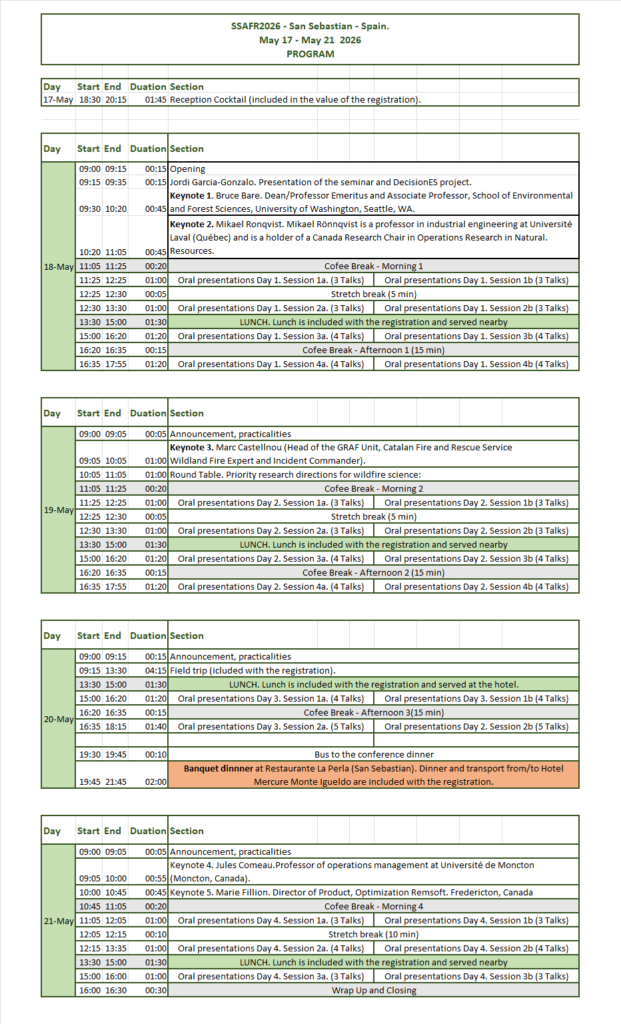
Program with presenters
Day 0. 17th May 2026. Registration Desk opens at 18:00. Wellcoming Cocktail at 18:30 – 20:00.

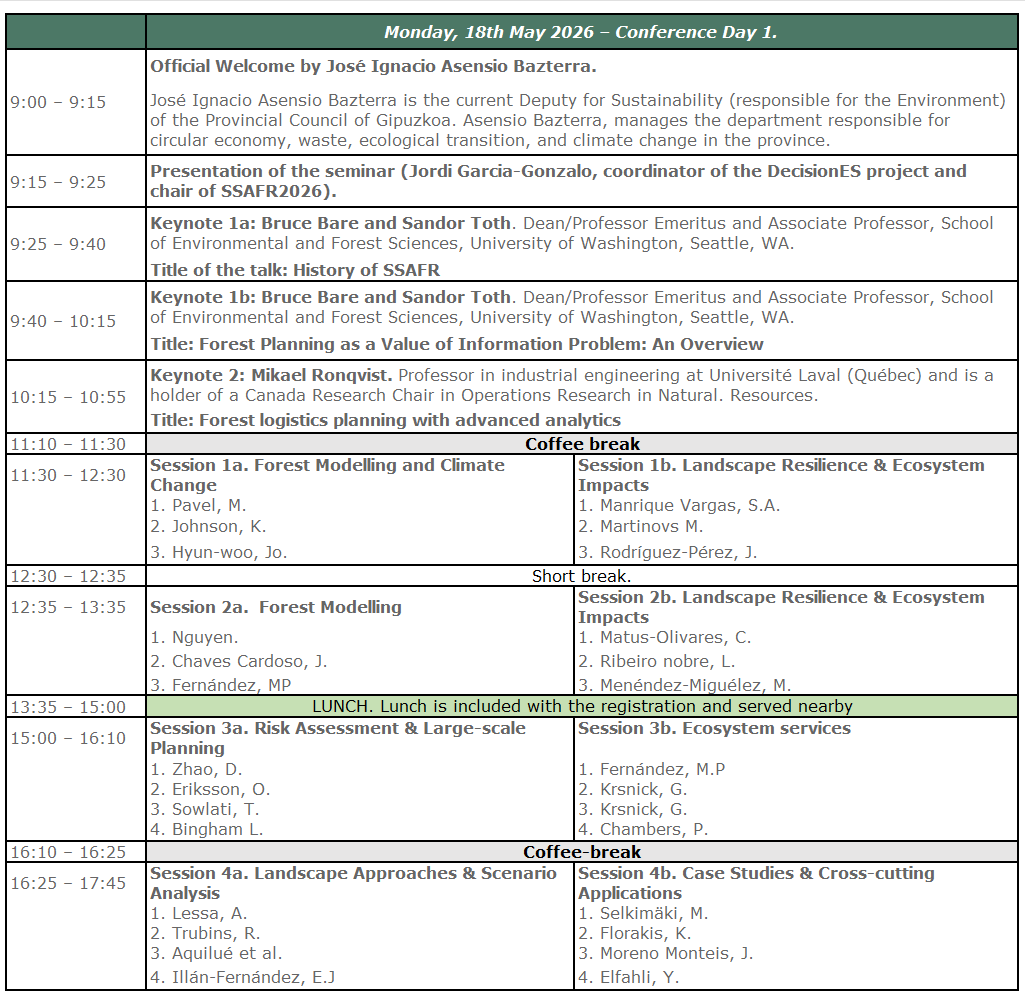
Day 1. 18th May 2026.
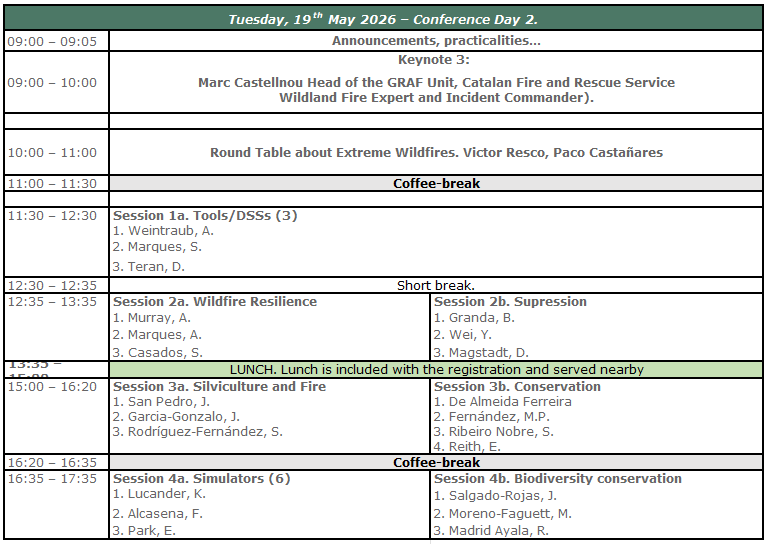
Day 2. 19 May 2026.
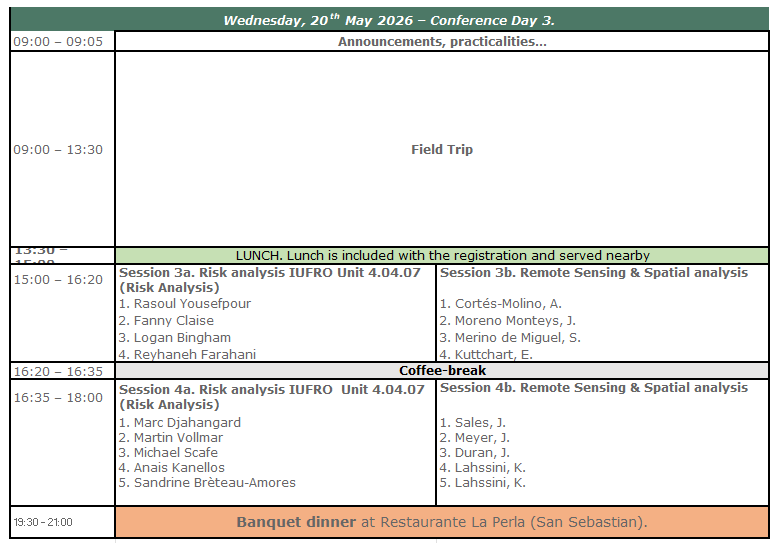
Day 3. 20 May 2026.
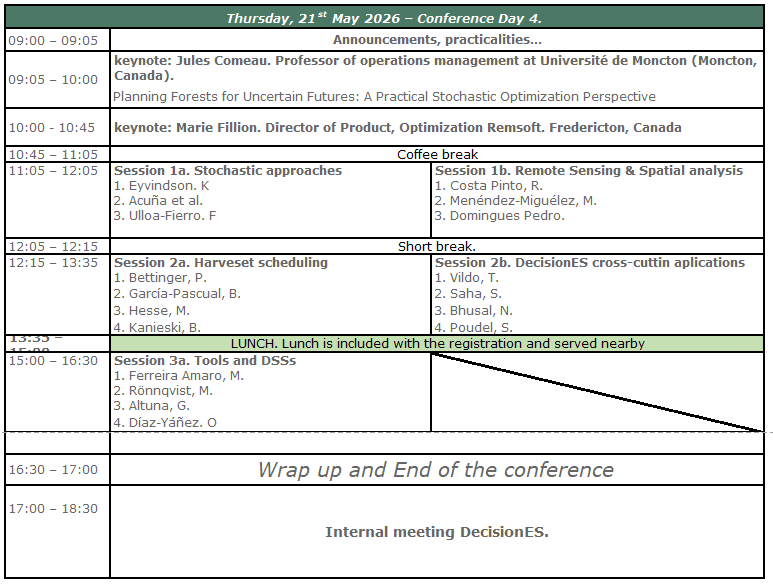
Day 4. 21 May 2026.
DOWNLOAD THE FULL PROGRAM WITH AUTHORS AND TITLES.
Here you can find the titles of all presentations distributed by sessions.
Keynote speakers
Day 1. Keynote 1a. Bruce Bare and Sandor Toth History of SSAFR
Day 1. Keynote 1b. Bruce Bare and Sandor Toth. Forest Planning as a Value of Information Problem: An Overview
Day 1. Keynote 2. Mikael Ronqvist Forest logistics planning with advanced analytics
Day 2. Keynote 3. Marc Castellnou Rethinking risk management
Day 2. Keynote 4. Victor Resco de Dios Moderator of a roundtable addressing the importance of wildfire prevention and the challenges involved.
Day 4. Keynore 5. Jules Comeau Planning Forests for Uncertain Futures: A Practical Stochastic Optimization Perspective
Day 4. Kaynote 6. Marie Fillion Common challenges in forest planning: Insights from practice.
Day 4. Kaynote 7. Marie Fillion Demonstrating integrated forest planning systems: A shift from model assembly to model
Day 1. Session 1a. Forest Modelling and climate change
1. Pavel Muha Abdullah. Al Climate Sensitive Model For Portuguese Maritime Pine Plantaitons Based on the 3PG model.
2. Krk Johnson. Modifying Stand-level Growth under a Changing Climate using a Model Fusion Approach.
3. Hyun-woo, Jo. An Integrated Forest Growth and Disturbance Modelling Framework for Assessing Climate, Management, and Carbon Trade-offs.
Day 1. Session 1b. Landscape Resilience & Ecosystem Impacts
1. Susan Angélica Manrique Vargas. Addressing water provision in Mediterranean forest management: a case study in Valle de Sousa, Portugal
2. Modris Martinovs. Integrated Forest and Hydrological Management for Sustaining Ecosystem Services under Global climate change
3. Javier Rodríguez-Pérez. Long-term temporal dynamics of the relationship between biomass and nutrient ratios and its effect on forest’s drought resilience
Day 1. Session 2a. Forest Modelling
1. Thanh Phuong Nguyen. Modelling the height-diameter curve for cork oak and stone pine growing in mixed stands in Portugal
2. Jessica Chaves Cardoso. Weekly growth is shaped by competition and microclimate in aspen–spruce mixtures
3. María Paulina Fernández. Ecological niche modelling of Jubaea chilensis as support for restoration programs.
Day 1. Session 2b. Landscape Resilience & Ecosystem Impacts
1. Camilo Matus-Olivares. Fire-Driven Shifts in Community and Functional Diversity of European Aerofauna in the Anthropocene
2. Luisa Ribeiro Nobre. From Snapshots to Trajectories: Geodatabase Historicity for Dynamic Ecosystem Services Monitoring
3. María Menéndez-Miguélez. Evaluating the ecosystem services of protective forests and nature-based solutions against natural hazards in the Pyrenees
Day 1. Session 3a. Risk Assessment & Large-scale Planning
1. Zhao, Dehai Revisiting Extended Rotations for Carbon Credits: Improved Basal Area Projection Models for Intensively Managed Pine Plantations
2. Ola Eriksson Carbon credits, do we get what we pay for? – an analysis of the proposal of the Swedish Cross-Party Committee on Environmental Objectives
3. Taraneh Sowlati T.Optimization of forest-based biomass to bioproducts supply chain considering governmental policies
4. Logan Bingham Degrowth, negative discount rates, and the Faustmann formula: an update
Day 1. Session 3b. Ecosystem services
1. María Paulina Fernández. Proposal for regulating ecosystem services modelling of urban trees as a decision-support tool.
2. Goran Krsnick. Let’s plan it green and multifunctional!
3. Goran Krsnick. Can forests have a vocation?
4. Philip Chambers. Gamified Augmented Reality for Citizen-Collected LiDAR Data in Urban Forest Inventory
Day 1. Session 4a. Landscape Approaches & Scenario Analysis
1. Andrey Lessa. Managing forests at the bioeconomy-biodiversity-climate nexus
2. Renats Trubins. Increasing the Share of Broadleaves in Southern Swedish Forests: Scenario Analysis of Alternative Targets and Transition Rates
3. Núria Aquilué. Scenario-based modelling of ecosystem services synergies and trade-offs under climate change
4. Illán Fernández. E.J. ForestDS: building the digital ecosystem for the forests of tomorrow
Day 1. Session 4b. Case Studies & Cross-cutting Applications
1. Mari Selkimäki. How forest owner preferences shape ecosystem service outcomes in landscape-level planning
2. Konstantinos Florakis. Spatial Site-Index Mapping from Repeated Top-Height Data Using EM Mixtures
3. Jan Moreno Monteis. Global Evolution Model of Forest Ecosystems from Individual Behavior: A Markov Process and Interaction-Based Approach
4. Yasser Elfahli Ontario. Spatial Equilibrium Model for Mass-Timber Development
Day 2. Session 1a. Tools and DSSs
1. Andrés Weintraub Analytic tools applied to forest fire prevention measures.
2. Susete Marques The use of a Cell-Based Forest Fire Growth Model to Support Strategic Landscape Management Planning in a Portuguese landscape.
3. Diego Teran FireScarMapper: A QGIS Plugin for Automated Burned Area Detection Using Deep Learning.
Day 2. Session 2a. Wildfire Resilience
1. Alan Murray. Enhancing Wildfire Resiliency Through Optimization of Mitigation Patch Compactness
2. Alexandra Marques A. methodology approach to enhance fire-resilience in forest-based value chains: a case study in Portugal
3. Sara Casados A. Stand-Level Decision-Support Framework for Assessing Post-Fire Recovery Trajectories in Mediterranean Forests
Day 2. Session 2b. Wildfire Supression
1. Bibiana Granda. Decision support during wildfire response using data-driven optimization – the HURRICANE project
2. Yu Wei. Data-driven fire spread prediction and suppression decision support
3. Shayne Magstadt. Cross-Agency Aerial Response to Wildfires Using ADS-B Flight Tracking Data
Day 2. Session 3a. Silviculture and Fire
37 1. Johanna San Pedro. Quantifying the Effects of Fuel Management and Suppression Efficiency on Wildfire Risk and Emissions in Europe
38 2. Jordi Garcia-Gonzalo. Addressing wildfire risk at landscape level combining MCA and optimization models
39 3. Sergio Rodríguez-Fernández. Addressing wildfire risk using a multi-methodological approach
Day 2. Session 3b. Conservation
1. Daniel De Almeida Ferreira. How effectively has GIS supported decision-making processes in ecological restoration?
2. Silvana Ribeiro Nobre. Evaluating Refloresta-SP as a Public Policy Instrument for Reconciling Economic and Ecological Functions in Forest Restoration
3. Esther Reith. Restoring Forests, Balancing Services: A Robust Optimization Approach
Day 2. Session 4a. Simulators
1. Klas Lucander. Impacts of Forest Growth Changes on the Swedish Forest Sector
2. Fermín Alcasena. Regional planning of multifunctional fuel treatments to mitigate wildfire risk in Navarra, Spain
3. Eunbeen Park. Future Wildfire Risk in Lower Austria Under Climate Change: A Stochastic Simulation Approach
Day 2. Session 4b. Biodiversity conservation
1. Jose Salgado-Rojas. From area targets to efficiency frontiers: a multi-objective framework for conservation planning
2. Matías Moreno-Faguett. An Exact ε-Constrained Optimization Framework for Balancing Efficiency and Risk Distribution in Spatial Restoration Planning
3. Victoria Madrid Ayala. A multi-objective spatial optimization framework for balancing restoration planning and production in intensive agricultural landscapes
Day 3. Session 3a. Risk analysis IUFRO unit
1. Rasoul Yousefpour. Impacts of US tariffs and duties on Ontario’s wood trade?
2. Fanny Claise. From Perceptions to Incentives: An empirical analysis of the Natural Insurance Function of European forests
3. Logan Bingham. Reflections on measuring deforestation that didn’t happen
4. Reyhaneh Farahani. Accounting for Extreme Disturbance Events in Forest Economic Evaluation under Climate Change
Day 3. Session 3b. Remote Sensing & Spatial analysis
1. Álvaro Cortés-Molino. Forest tree species prediction using PRISMA hyperspectral images and Graph Neural Network.
2. Jan Moreno Monteys. Global Evolution Model of Forest Ecosystems from Individual Behavior: A Markov Process and Interaction-Based Approach
3. Silvia Merino de Miguel. Integrating 3D Vegetation Structure and Time Series Remote Sensing to Understand Post-Fire Regeneration
4. Erico Kuttchart. Optimal allocation of solar-powered biorefineries supplied by forest and agricultural biomass in the Mediterranean region
Day 3. Session 4a. Risk analysis IUFRO unit
1. Marc Djahangard. FoRDM: A Toolkit for Robust Many-Objective Optimization to Support Forest Decision-Making Under Climate Change
2. Martin Vollmar. Development of tree species composition under Climate Change in the Harz region (Germany)
3. Michael Scafe. Evaluating the Robustness of Long-Term Forest Management Directions in Ontario, Canada Using Multi-Objective Robust Decision Making Under Deep Uncertainty
4. Anais Kanellos. The effect of fire frequency, timing and intensity on forest and welfare dynamics under perfect and imperfect anticipation of forest fire risk
5. Sandrine Brèteau-Amores. Mapping what matters: spatializing stakeholders’ perceptions of forest multi-risk to support adaptive governance
Day 3. Session 4b. Remote Sensing & Spatial analysis
1. Jomil Sales Mapping Nature’s Quality: Ecosystem Multifunctionality as a Basis for Environmental Fiscal Transfers in the State of São Paulo, Brazil
2. Joseph Meyer Structurally Guided Sampling, Theory and Applications.
3. Jordina Duran Combining Remote Sensing with AI Techniques to Predict Cropland Abandonment in Catalonia
4. Kamel Lahssini Euscanopy – A canopy height map of Euskadi
5. Kamel Lahssini Improving GEDI-Based Canopy Height Mapping Using Residual Kriging
Day 4. Session 1a. Stochastic approaches
1. Kyle Eyvindson. Planning for bark beetle disturbance in production forests: A regional forest optimization case study in Norway
2. Mauricio Acuña. Managing Thinning Decisions Under Fire Uncertainty: A Stochastic Programming Case Study in Southern Spain
3. Felipe Ulloa-Fierro. A Bayesian-Optimized Network Interdiction Heuristic for Firebreak Placement under Stochastic Wildfire Spread
Day 4. Session 1b. Remote Sensing & Spatial analysis
1. Costa Pinto, R. Vertical structure of vegetation across phytophysiognomies in the State of São Paulo based on canopy height models
2. Menéndez-Miguélez, M. Biomass Estimation In Overmature Trees: A New Methodology based on terrestrial laser scanning
3. Domingues Pedro. Assessing stream biological health through environmental-DNA and landscape context
Day 4. Session 2a. Harveset scheduling
1. Pete Bettinger. Issues in scaling forest harvest scheduling heuristics from small to larger landscape models
2. Borja García-Pascual. Integrating cut-to-length harvesting operations into spatially explicit thinning optimisation models
3. Maximilian Hesse. Improving cooperation in the forest-wood supply chain through participatory simulation: A case study of a Styrian paper mill
4. Bruno Kanieski. Timber Procurement under Competition: An Attacker–Defender Framework
Day 4. Session 2b. DecisionES cross-cutting aplications
1. Thiare Vildo. Spectral and Textural Sentinel-1 SAR Information for Fuel Type Classification in Sclerophyll Forests and Shrublands of Central Chile
2. Sajal Saha. Addressing Landscape Design Concerns by Combining a Wildfire Resistance Indicator with Adjacency Constraints.
3. Namrata Bhusal. Optimizing Forest Landscape Configurations to Reduce Wildfire Risk: Comparative Application in Portugal and Greece
4. Srijana Poudel. Expert-Based Parameter Estimation for Fuel Treatment Planning in Vale do Sousa, Portugal
Day 4. Session 3a. Tools and DSSs
1. Mariana Ferreira Amaro. Operationalising Data Governance in Forest 4.0: From Models to Implementation in the Portuguese Supply Chain
2. Mikael Rönnqvist. Pathfinder – a decision tool for efficient forest regeneration
3. Gorka Altuna. BASODATA: A data-driven digital infrastructure for Basque forest systems analysis, planning and decision support
4. Olalla Díaz-Yáñez. Forest Studio: An Integrated Modeling Framework for Forest Dynamics, and Management Decisions