Jordi Garcia-Gonzalo (Chair of the Symposium Organization and Science Committees and IUFRO Unit 4.04.04 deputy), José G. Borges (Coordinator of IUFRO Unit 4.04.04 and Member of the Symposium Organization and Science Committees), and Rasoul Yousefpour (Coordinator of IUFRO Unit 4.04.07 and Member of the Symposium Science Committee).
Summary: The SSAFR2026 (https://decisiones.ctfc.cat/SSAFR2026/ /) was the 21st of a series of symposiums on system analysis in forest resources. It brought together researchers and practitioners that develop and apply methods of optimization, simulation, management science, and systems analysis to forestry problems. It reported on the state-of-the art development and use of operations research and system analysis to enhance forest management planning.
Background: The SSAFR2026, 21st Symposium on System Analysis in Forest Resourceswas organized by Jordi Garcia-Gonzalo from the Forest Sciences and Technology Centre of Catalonia (CTFC) and it was sponsored by IUFRO Units 4.04.04 and 4.04.07 as well as by the project DecisionES - Decision Support for the Supply of Ecosystem Services under Global Change and partially sponsored by the Provincial Council of Gipuzkoa.This was the 21st Symposium in a series with previous conferences held in 1975, 1985, 1988, 1991, 1994, 1997, 2000, 2003, 2006, 2009, 2017 and 2022 in the USA, 1993, 2002, 2011 and 2019 in Chile, 2005 in Brazil, 2013 in Canada, 2015 in Sweden and 2024 in Spain. This series has long provided a) a venue for presentation of state-of-the-art applications of operations research and systems analysis in forest resources management planning and policy analysis, and b) opportunities for a fertile exchange of ideas among forest researchers and practitioners.
The Symposium: The SSAFR2026 took place May 17-21, 2026, in San Sebastian / Donostia, Basque Country, Spain. It involved 109 participants from 18 countries in Europe, Africa, America, Oceania and Asia. Its program encompassed 6 keynote presentations by Drs. Bruce Bare and Sándor Toth focusing on the history of SSAFR and on an overview of forest planning as a value of information problem, Dr. Mikael Ronqvist focusing on the use of advanced analytics in forest logistics planning, Dr. Jordi Garcia-Gonzalo focusing on the results of the EU Horizon 2020 project ‘FIRE-RES - Innovative technologies and socio-ecological-economic solutions for fire resilient territories in Europe’, Dr. Jules Comeau presenting a practical stochastic optimization perspective for planning forests for uncertain futures and Dr. Marie Fillon, who presented the Remsoft approach to application of optimization analytics for solving modern-day forestry planning challenges. It encompassed further a round table with Victor Resco and Paco Castañares on extreme wildfire events, two sessions led by IUFRO Unit 4.04.07 on Risk Analysis and 84 oral presentations organized into 24 sessions focusing on themes such as a) Forest Modelling and Climate Change, b) Landscape Resilience & Ecosystem Impacts, c) Risk Assessment & Large-scale Planning, d) Ecosystem services, e) Landscape Approaches & Scenario Analysis, f) Case Studies & Cross-cutting Applications, g) Simulators and Tools/DSSs, h) Wildfire Resilience, i) Wildfire Suppression, j) Silviculture and Fire, k) Restoration and biodiversity conservation, l) Risk analysis, m) Remote Sensing & Spatial analysis, n) Stochastic approaches, o) Harvest scheduling and p) DecisionES cross-cutting applications.
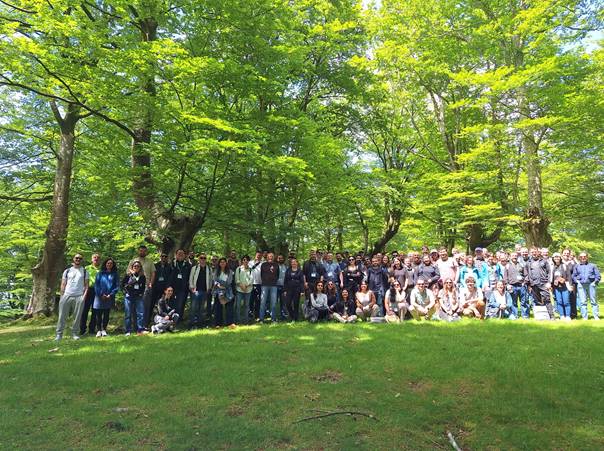
The conference worked well as a meeting place for experts on system analysis in a broad sense. It brought together researchers at very different stages of their careers, from PhD students to researchers taking part earlier in the SSAFR series, and from different continents. The arrangements in San Sebastian were ideal for the conference and the 4 days of scientific work included a much appraised field trip to a 530 hectares public forest owned by the Oiartzun Town Council and managed by the Forestry Service of the Provincial Council of Gipuzkoa, which is located within the Aiako Harria Natural Park, also a Natura 2000 Site. The forest hosts the largest pollarding beech forest in the Basque Country, covering around 250 ha and it contains one of the oldest conifer forest plantations in Gipuzkoa, on slopes with a high risk of erosion and at the headwaters of a river basin.
The SSAFR presenters were welcome to submit their research to be published in the Forest Monitor (https://forestsmonitor.com/) edited by Dr. Rafal Chudy at rafal@forestsmonitor.com)
Photographs:
Participants at the SSAFR2026 in San Sebastian / Donostia, Basqeu Country, Spain, May 17-21, 2026 (photo by Alejandro … )